


Abstract
Rare Earth Elements (REEs) are essential for advanced technologies due to their unique properties. This study presents a pHcontrolled solvent extraction method to separate Samarium (Sm) from light REEs simulating Beylikova REE leaching liquid. The process, utilizing 0.75 M DEHPA in kerosene, showed that Sm achieved a 59% extraction efficiency at pH 0.5, significantly higher than La, Pr, and Nd. This pH optimization enhances the sustainability and efficiency of REE extraction, promoting the effective utilization of Turkey’s REE resources and domestic technologies.
1. Introduction
Solvent extraction (SX) is a widely employed method for the separation and purification of rare earth elements (REEs). This technique involves the transfer of REE ions from an aqueous phase to an organic phase, facilitated by specific extractants, enriching the target elements from the solution. Due to the chemical similarities and close ionic radii among REEs, achieving high selectivity in their separation is often challenging. However, by adjusting various parameters such as pH and organic concentration, it is possible to influence the efficiency and selectivity of the solvent extraction process. In particular, optimizing the pH value can significantly impact the preferential separation of certain REEs over others.
2. Materials and Methods
This study presents a method for separating Samarium (Sm) from light REEs, namely lanthanum (La), praseodymium (Pr), and neodymium (Nd). The method involves a pH-controlled solvent extraction (SX) of the leach liquor, which was synthetically prepared according to Beylikova REE concentrate in Eskişehir, Turkey. For the investigation of the aqueous solution pH value
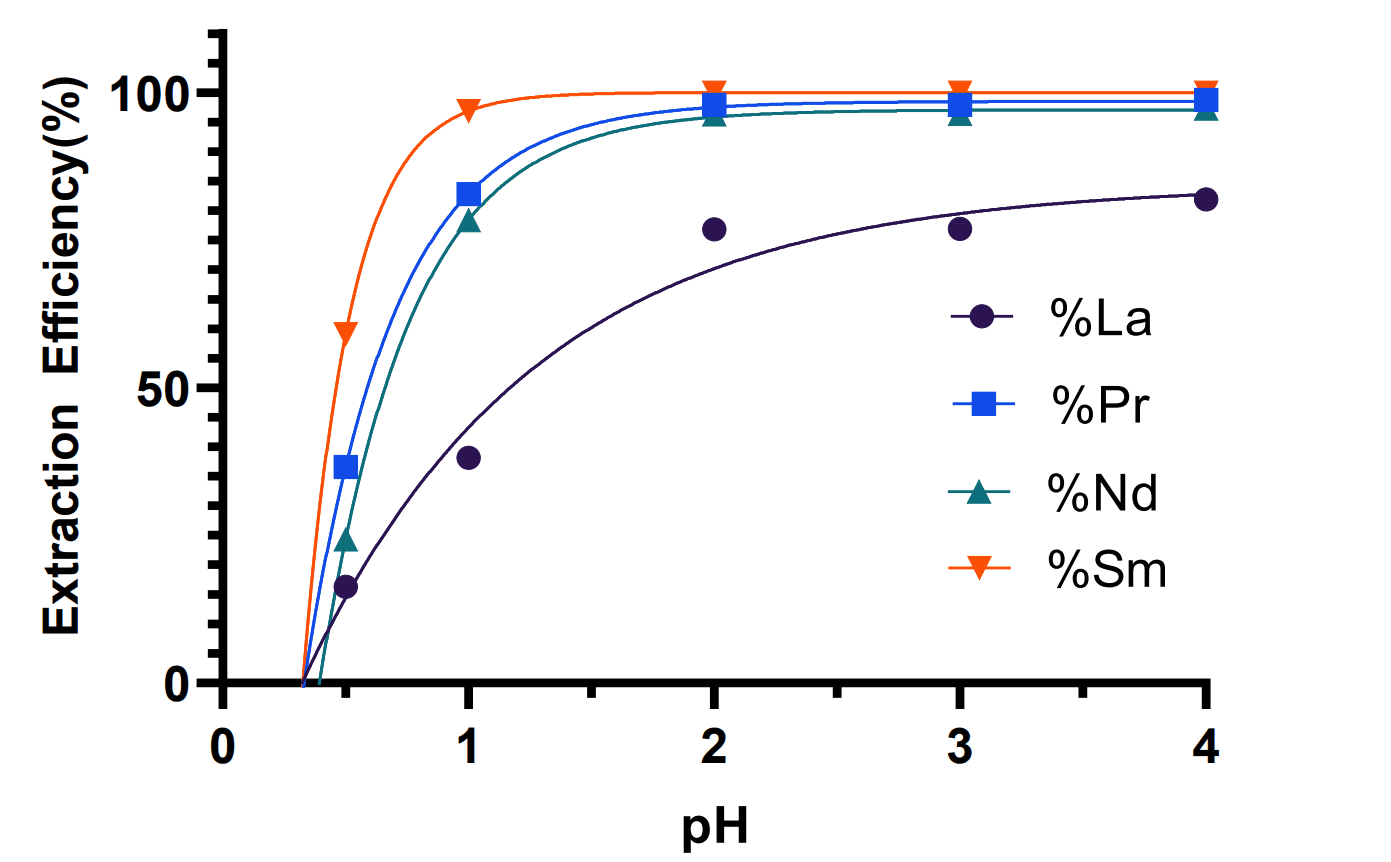
on the extraction efficiency of La, Pr, Nd, and Sm, the pH values were examined at different levels ranging from 0.5 to 4. SX of REEs was performed by using an organic phase consisting of 0.75 M DEHPA (Di-(2-Ethyl Hexyl) phosphoric acid) in kerosene. The concentrations of elements in the aqueous phase were quantified before and after the SX process by using inductively coupled plasma-optical emission spectroscopy (ICP-OES). The obtained results indicated that Sm exhibits remarkable performance in terms of an extraction efficiency of 59% at a lower pH value (i.e. 0.5) compared to those of La (16%), Pr (36%) and Nd (24%) as seen in Figure 1. The exceptional chemical behavior of Sm under acidic conditions enabled the formation of complexes with the organic phase, facilitating selective separation. This optimization in pH value improved the selectivity of the extraction process and established a more sustainable approach for the separation of REEs which possibly further minimizes the environmental impact typically associated with extraction of REEs.
3. Conclusion
This research outcome potentially supports the efficient utilization of Turkey’s REE resources and promotes the development of domestic technologies. The importance of pH value in separating Sm from light REEs in Beylikova REE leach liquor is highlighted which probably leads to the installation of more cost-effective and environmentally friendly REE extraction processes.
Acknowledgment
This study is coordinated and financially supported by TENMAK NATEN [Project No: A2.H1.P18].